Step inside a neighborhood gimbap shop or pork cutlet restaurant in Seoul, and you will inevitably encounter a curious piece of interior design.
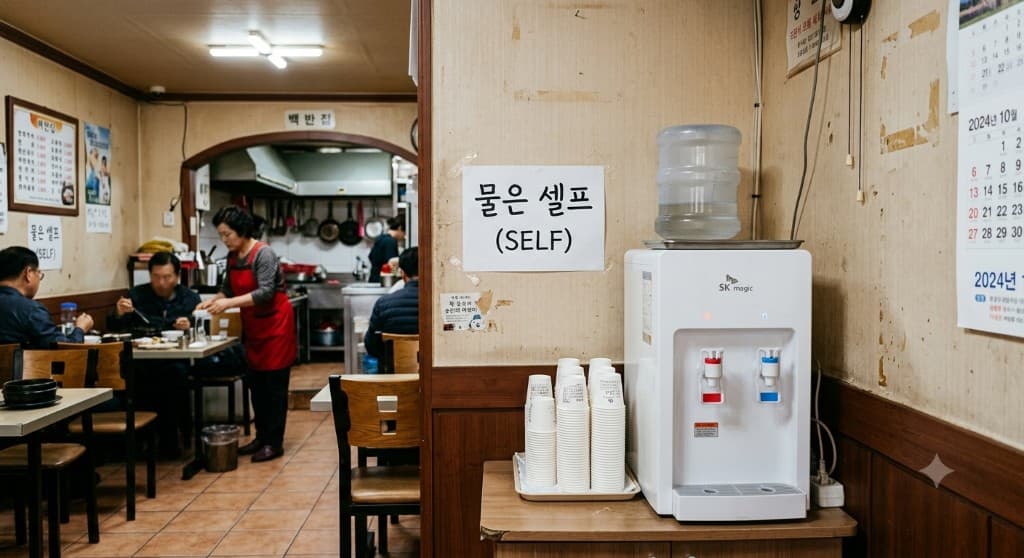
Taped near the water dispenser or printed directly on the wall is a laminated sign that reads, with absolute grammatical conviction: .
To a native English speaker, this phrase sounds like a fragment of broken existential philosophy. In English, "self" is a reflexive pronoun that demands a partner like "myself" or "yourself."
In Korea, however, "Self" has been unmoored from English syntax, converted into a standalone noun, and deployed as a complete imperative sentence.
How did a complex foreign concept get squeezed into a three-syllable operational command?
The answer lies in the pragmatic engineering of the Korean speech engine.
1. The Phonological Engine — Why 3 Syllables Rule
Quick Summary: Konglish truncations are not grammatical errors; they are phonological adaptations designed to fit the fast-paced, 2-to-3 syllable rhythm of spoken Korean.
When foreign words enter the Korean language, they undergo immediate physical modification. Native speakers do not treat loanwords as sacrosanct tokens of foreign culture.
Instead, loanwords are forced into the native vocal machinery, stripped of unnecessary phonetic mass, and resized for maximum efficiency.
The Physics of Speech Economy
Korean is a syllable-timed language where each block in Hangul carries roughly equal duration and rhythmic weight.
English, by contrast, relies on stress-timing, squishing unstressed syllables between heavy accents.
When an English word like "Air Conditioner" enters spoken Korean, it translates phonetically into —a staggering six syllables.
Saying six syllables every time you want to lower the room temperature creates massive friction in daily dialogue.
Why Long Words Break Korean Cadence
In conversational Korean, the sweet spot for high-frequency nouns is strictly two to three syllables.
Words that exceed three syllables disrupt the breath control and natural cadence of rapid speech.
To solve this, Korean speakers chop off the trailing end of foreign words without hesitation.
"Air Conditioner" loses its last three syllables and becomes .
"Remote Controller" drops its tail to become .
This process is not laziness or accidental slang; it is intentional phonological compression.

2. The Three Categories of Koreanized English
Korea reshapes imported English vocabulary using three distinct structural mechanisms.
Understanding these categories allows you to decode almost any piece of "Konglish" you encounter on the streets of Seoul.
Systematic Deconstruction
The first mechanism is Truncation (Clipping), where the tail end of a long word is excised.
Words like for apartment or for job qualifications follow this exact pattern.
The second mechanism is the Portmanteau, which fuses the leading syllables of two separate words into a single unit.
The word combines "Self" and "Camera" to describe a selfie, while truncates "Health Club" down to mean gym or fitness training.
The third mechanism is Pseudo-English (Functional Re-engineering), where English roots are combined to create brand-new vocabulary that does not exist in English-speaking nations.
Terms like for a studio apartment and for a mobile phone were engineered in Asia to fill precise functional gaps.
| Category | Original English | Koreanized Form | Actual Meaning |
|---|---|---|---|
| Truncation | Air conditioner / Remote controller | 에어컨 (Aircon) / 리모컨 (Remocon) | Cooling unit / Remote control |
| Portmanteau | Self + Camera | 셀카 (Sel-ca) | Selfie |
| Pseudo-English | One + Room / Hand + Phone | 원룸 (One-room) / 핸드폰 (Handphone) | Studio apartment / Mobile phone |
| Functional Shift | Self-service | 셀프 (Self) | "Get it yourself" |
3. The "Water is Self" Phenomenon — Functional Grammar Hijacking
The wall sign represents the ultimate evolution of functional Korean compression.
In standard English, the full instruction is: "Water is self-service."
In a busy Korean eatery, however, the word "service" is redundant context.
Stripping the Redundant
Korean grammar routinely drops subjects, objects, and polite modifiers whenever the physical setting makes the meaning obvious.
By stripping "service" away from "self-service," Korean speakers isolated the core operational word: .
In five short Hangul characters, conveys a dense paragraph of instructions.
It tells the customer: "Do not call the waiter for water; stand up and fetch it yourself from the stainless steel purifier near the kitchen."
It turns a descriptive adjective into a direct, absolute rule of venue operation.
Pro-Tip: How to Read Konglish Like a Local
Strip the English word down to its first 2–3 syllables, evaluate the physical context, and ignore English dictionary grammar.
If you are in a restaurant, "Self" is an operational rule, not a reflexive pronoun.
4. Quick Guide — Essential Konglish Words for Daily Life
Master these fundamental truncated terms to navigate daily life in Korea smoothly:
The quintessential 3-syllable truncations for the air conditioner and remote control.
The universal Korean word for a selfie, combining "self" and "camera."
The standard real estate term for a single-room studio apartment.
The universal restaurant notification indicating self-service water and side dishes.
Understanding these speech patterns reveals that Koreanized English is not broken grammar.
It is a remarkably efficient, streamlined vocabulary system built specifically for the tempo of modern Korean life.
Reactions & Next Steps
If this breakdown helped you understand the mechanics behind Korean loanwords, let us know by selecting a reaction below!
- Visual Stories: For artwork, illustrations, and daily glimpses into our multicultural family life in Seoul, follow Sofie Fribo on Instagram: @sofiefribo_illustration.
- Up Next: Ever wondered why Koreans use the word "fighting!" (파이팅) to cheer someone on? In our next article, we will analyze the linguistic shift from physical conflict to social encouragement.