The Vocabulary Fallacy vs. Rhythmic Chunking
Most language learners treat the days of the week as an exercise in brute-force memorization. They attempt to memorize seven standalone vocabulary items: **월요일, 화요일, 수요일, 목요일, 금요일, 토요일**, and .
This dictionary approach creates immediate mental friction. Every time you need to say "Wednesday," your brain pauses to run through a list, manually calculating each word from scratch.
Korean is best learned through natural sound rhythms, cultural cadence, and sound chunking rather than isolated grammar rules. When you internalize the underlying speech cadence first, your vocal muscles memorize the sequence effortlessly.
The Universal Beats: Why 4-3 Rhythms Rule Korean
Human memory relies heavily on rhythmic patterns rather than isolated bits of data. Structuring information into balanced beats allows your brain to store phrases as automatic vocal patterns.
You can observe this rhythmic tendency across Korean culture. Sports fans unite stadium chants using a universal 3-3-7 clapping rhythm, and children learn consonant order through a 4-3 beat: (4 beats) followed by (3 beats).
Modern Korean speech naturally favors 3-4 syllable sound blocks. Everyday expressions are constantly condensed into tight rhythmic units, such as (remote control), (air conditioner), (water is self-service), and (bought with my own money).
The 4-3 Rhythm Structure: 월화수목 + 금토일
Instead of memorizing seven separate words, you can master the days of the week through a simple two-step structure.
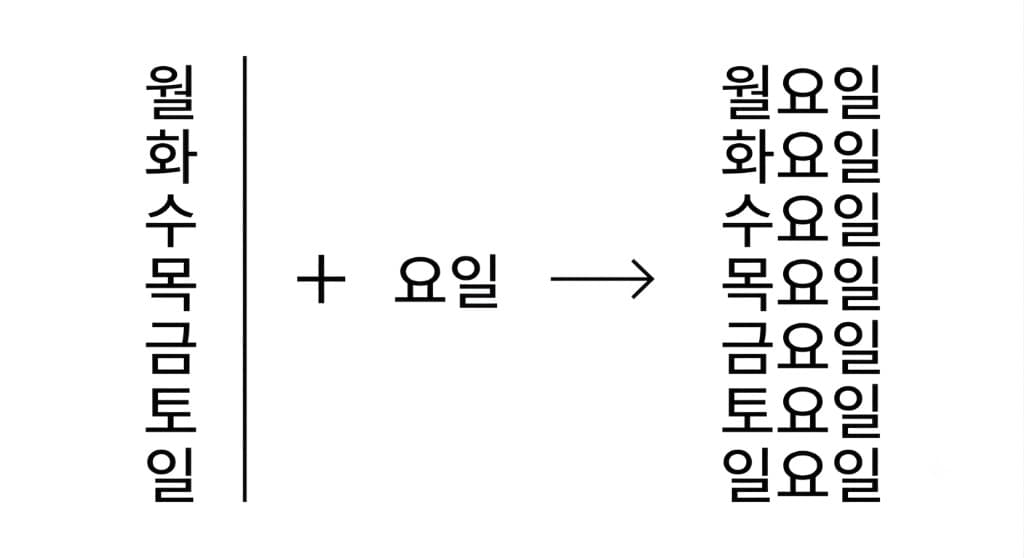
Step 1: Master the Base Rhythm. Remove the repeated functional suffix (yo-il, meaning "day") and focus entirely on the core seven syllables. Practice them in a clear 4-3 cadence: (4 beats) followed by (3 beats). Repeat aloud until all seven syllables flow smoothly as one continuous phrase.
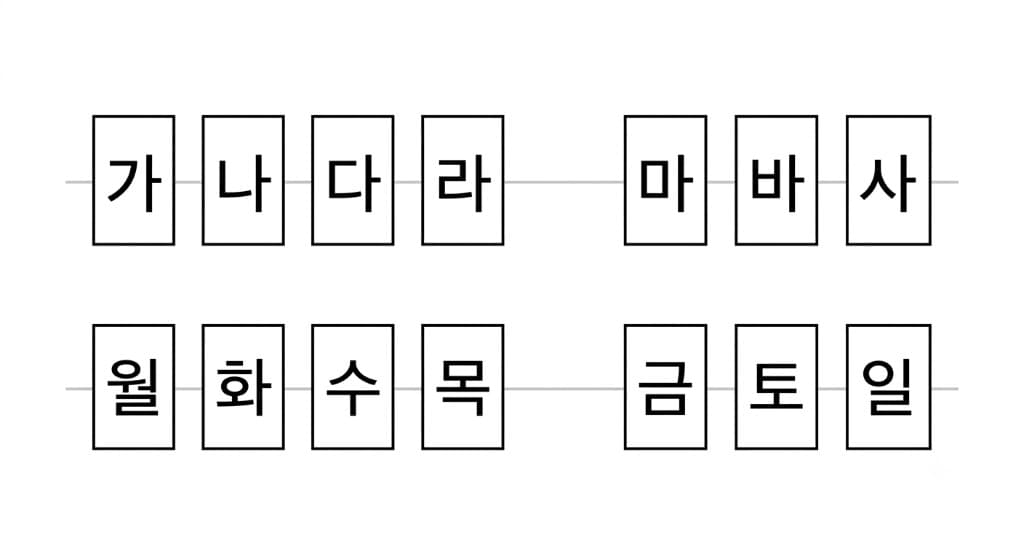
Once this 4-3 base rhythm is established in your vocal memory, simply add the suffix (yo-il) to whichever base syllable you need. For example, take from your 4-3 base rhythm and add to form (Su-yo-il).
Practice with Uncle Hangul
Train your vocal muscles with Uncle Hangul's video walkthrough: "From Monday to Sunday, in Korean?".
Follow along with the video using these timestamped guides (video runtime: 5:59):
- **
[01:40]Internalizing the core 4-3 rhythm beat**: Listen and chant along with to build cadence. - **
[02:48]Adding the suffix "-요일"**: Practice attaching to individual base syllables cleanly. - **
[03:00]Mastering natural sound softening (연음 현상)**: Experience how + smoothly connects into (Wol-yo-il) through natural speech flow.
Summary, Vocabulary Card & Homework Challenge
Focusing on speech cadence removes the need to recalculate vocabulary on the spot. Anchor the 4-3 cadence in your vocal tract, add the suffix when speaking, and let natural speech rhythm guide your fluency.
Review this core vocabulary table for your daily vocal practice:
| Day | Hangul | Romanization | Meaning |
|---|---|---|---|
| Monday | Wol-yo-il | Monday | |
| Tuesday | Hwa-yo-il | Tuesday | |
| Wednesday | Su-yo-il | Wednesday | |
| Thursday | Mok-yo-il | Thursday | |
| Friday | Geum-yo-il | Friday | |
| Saturday | To-yo-il | Saturday | |
| Sunday | Il-yo-il | Sunday | |
| Weekend | Ju-mal | Weekend |
📝 Homework Challenge
Which day of the week is your favorite?
Use the 4-3 rhythm structure to find your favorite day, write it in bold Korean (**월요일, 금요일**, etc.), and post it in the YouTube video comments section so Uncle Hangul can review your work directly!